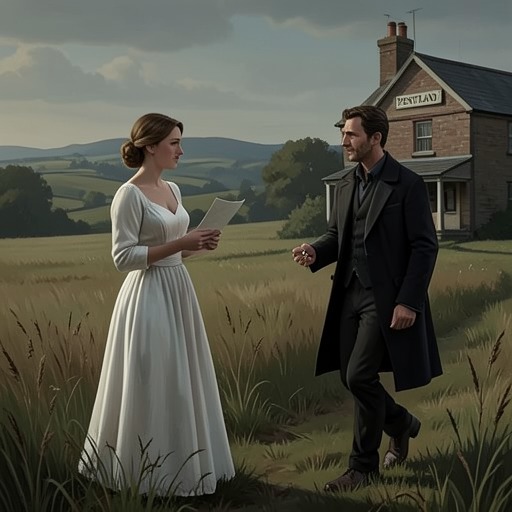
Nominal Platonic marriage
Just DesertsThe novel presents the platonic marriage as a formally valid but deliberately unconsummated union between Elizabeth Bennet and Sir David Pentland. Sir David proposes it while Elizabeth is being courted by Fitzwilliam Darcy, not to displace her love but to secure her control of Grenadine Reef after his rapidly approaching death. The arrangement exposes marriage as both a legal mechanism and an emotional sacrifice: it protects a woman from economic dependence while requiring her to postpone the marriage she expects to make for love.
Definition and Circumstances
The arrangement arises from Sir David’s declining health and his fear that Grenadine Reef will not remain in Elizabeth’s care after his death. He tells Elizabeth, Darcy, and the Gardiners that he is dying and that his body is deteriorating quickly. His proposal is therefore not an ordinary courtship but a request for a marriage whose practical purpose is already defined: Elizabeth will become Lady Pentland, then control the estate as his widow.
Sir David states that the marriage will be platonic and unconsummated. He describes the offer as a way to give Elizabeth independence and entrust her with the home that he and Lady Radha Pentland created, while also admitting that he wants her to care for Grenadine Reef during the last part of his life. The arrangement is affectionate but not romantic in the conventional marital sense. Sir David loves Elizabeth like the granddaughter he never had, and the marriage gives legal form to that chosen family relationship.
Property, Law, and Female Independence
The proposal gains its force from the restricted property position of women in the novel’s society. Elizabeth understands that women generally do not control real property: authority rests first with their fathers and, after marriage, with their husbands. Widowhood is the crucial exception. By marrying Sir David and surviving him, Elizabeth can become responsible for Grenadine Reef rather than leaving the estate to be sold or transferred away from the people who depend upon it.
The plan is prepared through a new will and a marriage settlement. Sir David has James Pentland ready to witness the documents, while a doctor and the local magistrate have attested that he is of sound mind. The proposed legal structure is unusually direct because there are no children whose provision must be arranged and no conventional widow’s treatment or settlement that needs to be calculated. Apart from specific bequests to James Pentland, his named children, Sir David’s valet, and other long-serving servants, the estate is to pass to the widow.
The economic foundation makes the arrangement more than a symbolic gesture. Sir David’s wealth began with his 1770 command of HMS Glory and the recovery of treasure from a Spanish galleon wrecked on a reef near the Grenadine Islands. His knighthood and share of the prize enabled the purchase of Grenadine Reef. The Pentlands then lived quietly and invested their surplus rather than spending heavily on London seasons, elaborate entertaining, children’s education, dowries, or a Grand Tour. By the time of Sir David’s death, Elizabeth inherits assets worth £400,000, generating nearly £20,000 a year after tax. The platonic marriage thus converts maritime prize wealth and disciplined investment into a woman’s legal and domestic independence.
The Emotional Cost of the Bargain
Elizabeth’s acceptance is not emotionally simple. Only the previous evening she had expected to marry Darcy within weeks. She knows that her love for Darcy is real and that he returns it. Sir David’s proposal forces her to choose between the immediate fulfilment of that love and the future of Grenadine Reef, including its servants, tenants, and dependent households.
Her attachment to the Pentlands is itself a form of love. Lady Radha had been an anchor during Elizabeth’s early adolescence and a more important maternal presence than Elizabeth’s own mother. After Lady Radha’s death, Elizabeth’s relationship with Sir David deepened under the constraints of propriety, although both understand that society’s rules, rather than any lack of affection, had kept their intimacy formally restrained. His proposal gives spoken form to a long-standing bond while making Elizabeth responsible for preserving its material legacy.
The arrangement also exposes an irony in Elizabeth’s principles. She has condemned a society in which women are effectively sold in marriage and has insisted that marriage should arise from the deepest love rather than from property or family calculation. Sir David’s offer is the ultimate marriage transaction: Elizabeth receives independence and an estate, while he receives the assurance that Grenadine Reef will remain in the hands of someone who loves it. The difference is that Elizabeth is not coerced into sexual submission or transferred as property; she knowingly accepts the legal bargain in order to protect a community and secure her own future.
Ceremony, Death, and Immediate Consequences
Elizabeth accepts the proposal and promises to maintain the legacy created by Sir David and Lady Radha. Darcy is torn because supporting the arrangement means accepting a delay in his own happiness, while opposing it would endanger Elizabeth’s independence and the estate she loves. Sir David recognizes the emotional pressure he is exerting, but his illness has reduced the time available for any less disruptive solution.
Six days after proposing, Sir David marries Elizabeth by common licence. The ceremony is physically difficult because he must be carried into the church in a chair and can no longer walk. Elizabeth’s uncle Edward Gardiner escorts her down the aisle, Lily serves as maid of honour, Darcy attends, and many servants and tenants fill the small church. Their presence makes the ceremony a public declaration that Elizabeth is accepted as the new mistress of Grenadine Reef. Sir David, who had converted to the Church of England after Lady Radha’s death, is married under its rites by a local vicar who knows him.
The marriage lasts only briefly. After the tenant-centered wedding breakfast, Sir David retires to his room in pain, having taken laudanum to endure the effort of leaving the house. He never leaves the bedroom alive again. Elizabeth sits with him for long periods, reading aloud on Friday and Saturday, and wakes on Sunday as his widow. His body is confirmed by the vicar, the local magistrate, James Pentland, Darcy, and Edward Gardiner, then interred beside Lady Radha. The platonic marriage therefore reaches its legal purpose almost immediately, but its emotional consequences continue: Elizabeth must grieve while assuming responsibility for a large estate and the people attached to it.
Narrative and Thematic Significance
The marriage functions as a pointed revision of the conventional romantic plot. Elizabeth and Darcy’s love remains intact, but the expected progression from courtship to wedding is interrupted by a different union whose purpose is protection, succession, and stewardship. The story consequently separates emotional fulfillment from legal marriage without treating either as false. Elizabeth’s marriage to Sir David is not presented as a rival to her love for Darcy; it is a temporary and sacrificial institution that makes a later life of independence possible.
It also reverses the usual power direction of marriage. Sir David does not acquire Elizabeth’s labour, obedience, or property. Instead, he uses his legal authority and wealth to place control of Grenadine Reef in her hands. The arrangement converts widowhood from a condition of vulnerability into a position of command. Elizabeth becomes responsible for maintaining the estate, preserving its social world, and carrying forward the memory of both Pentlands.
The legacy remains visible in the epilogue. After Elizabeth and Darcy marry, they divide their estates among their children and preserve the part of Grenadine Reef associated with the dower house. They build St. Vincent Lodge on the final 1,000 acres, naming it for the island nearest the place where Sir David discovered the wrecked treasure ship. The property’s later organization confirms that his marriage proposal was not merely a desperate expedient: it established a continuing female-centered chain of stewardship, linking Elizabeth’s widowhood, the Pentland legacy, and the future management of the estate.